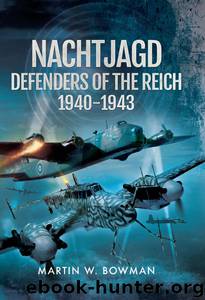
Nachtjagd, Defenders of the Reich 1940-1943 (The Second World War By Night) by Martin Bowman
Author:Martin Bowman [Bowman, Martin]
Language: eng
Format: azw3
Tags: HISTORY / Military / World War II
ISBN: 9781473849846
Publisher: Pen and Sword
Published: 2016-01-31T05:00:00+00:00
Endnotes Chapter 8
86 The Stirlings were withdrawn from an original plan so that only the higher-flying heavies would participate and most of the force came from 5 Group.
87 Figures on a clock face, i.e. East to West in the northern part of the night fighting area.
88 All the crew were lost without trace and are commemorated on the Runnymede Memorial. On both raids - 16/17th and 17/18th January the Path Finders were unable to mark the centre of Berlin and bombing was inaccurate. The experiments with the Lancaster-Halifax force using TIs against the ‘Big City’ now ceased until H2S became available. 35 major attacks were made on Berlin and other German towns during the Battle of Berlin between mid-1943 and March 1944; 20,224 sorties, 9,111 of which were to the big City. From these sorties (14,652 by Lancasters), 1,047 aircraft FTR and 1,682 received varying degrees of damage. AM Sir Arthur Harris said later, ‘We can wreck Berlin from end to end if the USAAF will come in of it. It will cost between 400-500 aircraft. It will cost Germany the war.
89 Adapted from the Bomber Command Assoc Newsletter, No.28 February 1995.
90 All except two of his crew survived.
91 The Bomber Command War Diaries by Martin Middlebrook and Chris Everitt (Midland 1985)/The Lent Papers by Peter Hinchliffe.. NJG1 were credited with thirteen kills. Three crews of IV./NJG1 destroyed four bombers over the northern province of the Netherlands.
92 The Bf 110F was unable to fly on one engine when carrying night fighting equipment.
93 ‘Oboe’ was the most accurate form of high-level blind bombing used in World War II and it took its name from a radar pulse, which sounded like a musical instrument. The radar pulses operated on the range from 2 ground stations (‘Cat’ and ‘Mouse’) in England to the target. The signal was heard by both pilot and navigator and used to track the aircraft over the target. If inside the correct line, dots were heard, if outside the line, dashes, a steady note indicated the target was on track. Only the navigator heard this signal. When the release signal, which consisted of 5 dots and a 2-second dash was heard, the navigator released the markers or bombs. In April 1942 109 Squadron was established at Stradishall, Suffolk to bring ‘Oboe’ into full operational service as a navigation aid for Bomber Command before moving to Wyton in August, where at the end of the year, it received the first ‘Oboe’-equipped Mosquito BIVs. ‘Oboe’ was first used on 20/21 December 1942 when the CO, Squadron Leader H. E. ‘Hal’ Bufton and his navigator, Flight Lieutenant E. L. Ifould and 2 other crews, bombed a power station at Lutterade in Holland. On 31 December 1942/1 January 1943, on a raid on Düsseldorf, sky-marking using ‘Oboe’ was tried for the first time when 2 Mosquitoes on 109 Squadron provided the sky-markers for 8 Lancasters on the Path Finder Force. ‘Sky markers’ were parachute flares to mark a spot in the sky if it was cloudy.
Download
This site does not store any files on its server. We only index and link to content provided by other sites. Please contact the content providers to delete copyright contents if any and email us, we'll remove relevant links or contents immediately.
| Africa | Americas |
| Arctic & Antarctica | Asia |
| Australia & Oceania | Europe |
| Middle East | Russia |
| United States | World |
| Ancient Civilizations | Military |
| Historical Study & Educational Resources |
The Radium Girls by Kate Moore(12120)
100 Deadly Skills by Clint Emerson(4984)
Rise and Kill First by Ronen Bergman(4859)
The Templars by Dan Jones(4751)
The Doomsday Machine by Daniel Ellsberg(4578)
The Rape of Nanking by Iris Chang(4276)
Killing England by Bill O'Reilly(4065)
Stalin by Stephen Kotkin(4025)
Hitler in Los Angeles by Steven J. Ross(3993)
12 Strong by Doug Stanton(3590)
Hitler's Monsters by Eric Kurlander(3412)
The Code Book by Simon Singh(3269)
Blood and Sand by Alex Von Tunzelmann(3257)
Darkest Hour by Anthony McCarten(3187)
The Art of War Visualized by Jessica Hagy(3058)
Hitler's Flying Saucers: A Guide to German Flying Discs of the Second World War by Stevens Henry(2785)
Babylon's Ark by Lawrence Anthony(2744)
Tobruk by Peter Fitzsimons(2575)
The Second World Wars by Victor Davis Hanson(2559)
